A choking emergency gives you seconds, not minutes, to work with. There’s no time to look something up once it starts.
The response follows the same basic sequence for adults and children over one year old: encourage coughing, then back blows, then chest thrusts, escalating until the object clears or the person stops responding. Infants need a modified version of that same sequence, adjusted for how fragile they are.
Choking and suffocation are the fifth leading cause of injury deaths in Australia, according to the Australian Institute of Health and Welfare, with rates highest in children aged 0 to 4. Most people know something should be done. Far fewer know the actual sequence, or freeze at the point where escalation is needed.
Below is the step-by-step response for a conscious adult, a conscious child, a conscious infant, and what changes if the person stops responding.
Prepare for the unexpected. Join Business Wise First Aid Training for an industry-leading first aid course in Newcastle. With a 5-star rating and over 100 glowing reviews, we provide the practical skills you need to respond with confidence.
Choking Response for a Conscious Adult
Start by encouraging them to cough. A forceful, productive cough is the airway clearing itself, and it’s more effective than anything you can do manually. Don’t interrupt it. Stay calm and let it run its course.
If coughing is ineffective at clearing the blockage, call Triple Zero (000) for an ambulance. From there, follow this sequence:
- Bend Forward: at the waist, with their head and chest low.
- Give Back Blows: up to 5 sharp blows between the shoulder blades, using the heel of one hand. Check after each blow to see if the object has cleared.
- Try Chest Thrusts: if back blows don’t work, give up to 5 chest thrusts. Support their back with one hand, and use the heel of your other hand on the lower half of the sternum, the same position as CPR compressions but sharper and slower. Check after each thrust.
- Keep Alternating: 5 back blows and 5 chest thrusts until the object clears or emergency help arrives.
If the person turns blue, goes limp, or loses consciousness at any point, stop and move straight to the unresponsive response below.
Choking Response for a Conscious Infant (Under 1 Year)
Call Triple Zero (000) immediately for an infant. Don’t wait to see if coughing clears it first, infants can’t reliably produce the kind of forceful cough that clears an airway, and they deteriorate faster than adults or older children.
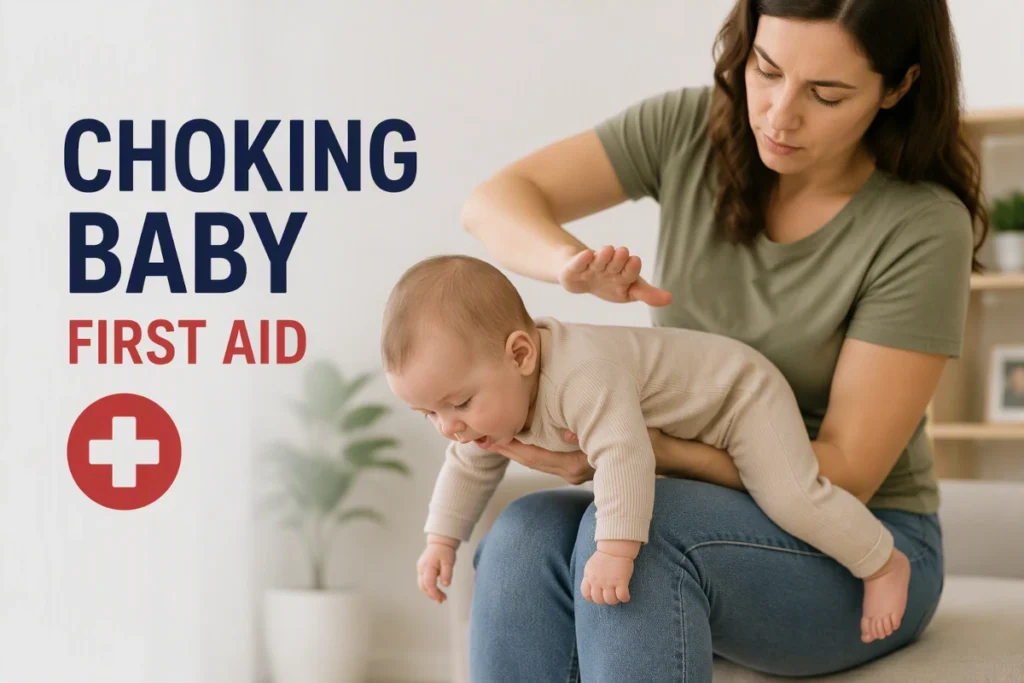
- Position the Infant: face-down along your forearm, supporting their head and shoulders with your hand, head angled lower than the body. Hold their mouth open with your fingers.
- Give Back Blows: up to 5 sharp blows between the shoulder blades with the heel of one hand. Check visually after each blow.
- Turn the Infant: if unsuccessful, turn them face-up on a firm surface. Place 2 fingers on the lower half of their breastbone.
- Give Chest Thrusts: up to 5, sharper and slower than CPR compressions. Check after each one.
- Keep Alternating: 5 back blows and 5 chest thrusts until the blockage clears or help arrives.
Choking Response for a Conscious Child (Over 1 Year)
The technique is identical to the adult response. What changes is scale, positioning, and force.
Kneel down to the child’s height rather than having them stand and lean over, it’s easier to support them and control the blows. Use the same heel-of-hand back blows and chest thrusts, adjusted to a size and force appropriate for a smaller body. The sequence is the same: encourage coughing, call 000 if that doesn’t clear it, then alternate 5 back blows with 5 chest thrusts.
Children can panic faster than adults in a choking episode, which makes them harder to keep still. Keeping your own voice calm matters as much as the technique itself, since a panicking child fights the positioning you need them in.
What to Do if They Stop Responding
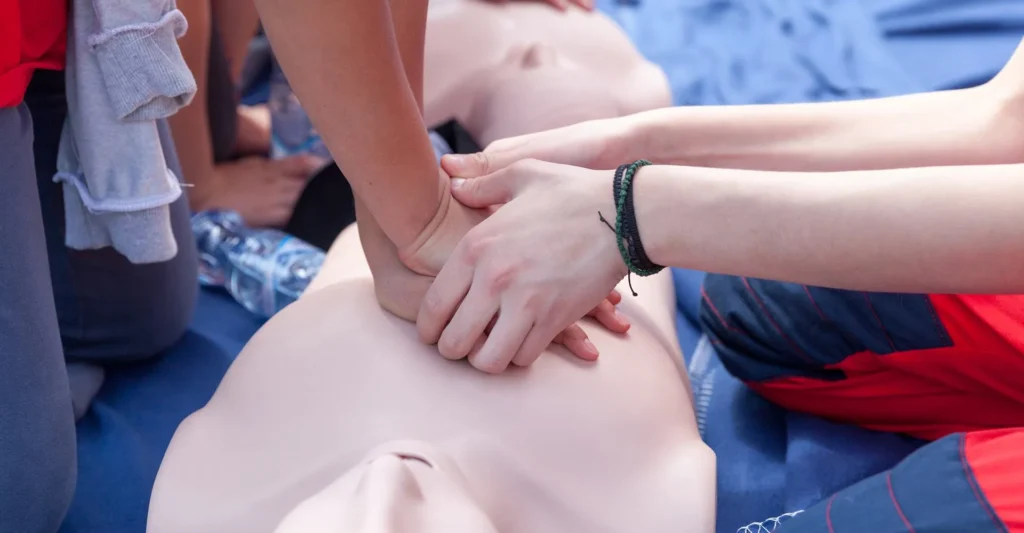
If a choking person becomes unconscious at any age, stop the back blows and chest thrusts and start CPR immediately, beginning with chest compressions. Call 000 if you haven’t already, and keep it on speaker so you can follow the operator’s instructions while you work.
Before each set of rescue breaths, look inside the mouth. If you can see the object, remove it. Don’t do a blind finger sweep, you risk pushing it further down. Continue CPR until the person starts breathing on their own, emergency services arrive, or you’re physically unable to continue.
Note: this sequence assumes you’ve already been trained in CPR and DRSABCD. If you haven’t, reading the steps once isn’t the same as being able to perform them under pressure, which is the entire reason practical first aid training exists.
First Aid Courses
Business Wise First Aid Training runs the following courses across Newcastle and surrounding NSW regions, covering choking response, CPR, and the full range of first aid scenarios with hands-on practice:
- HLTAID009 Provide Cardiopulmonary Resuscitation
- HLTAID011 Provide First Aid
- HLTAID012 Provide First Aid in an Education and Care Setting
Visit Business Wise First Aid Training to see current course dates and locations.